Two weeks ago I said the loop that fails to learn is not the machine’s. It is the one you wrote. Audit the protocol, not just the output. Here is what sits underneath the protocol.
A protocol governs something. If the something is four silos, three competing sources of truth, and a process nobody has ever written down, you can audit your instruction set every Friday and still lose.
Go back to the two signs at the top of Khardung La. The real fault was not that a number was wrong. It was that nobody retired anything. They left the old sign standing, built a new one beside it, and both stayed.
That was never a signage problem. That is how organisations are built.
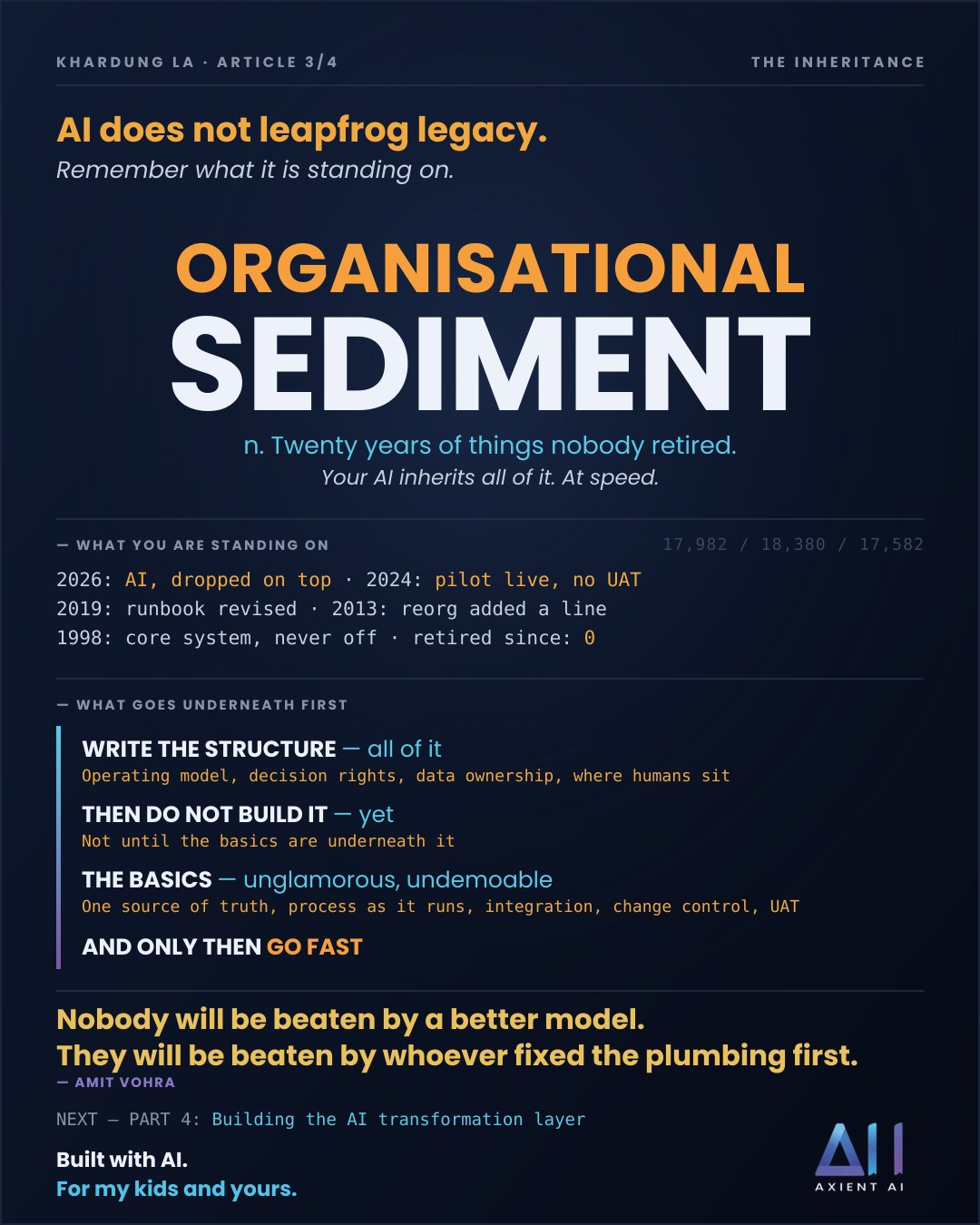
Every reorganisation adds a reporting line. None removes one. Every system goes in. None comes out. Every policy layers on the last, and the last never comes down. Twenty years of that and you are not running a company, you are running sediment.
Legacy is not your mainframe. Legacy is your structure, and the thinking that keeps adding to it.
Now introduce AI to that.
It will not vault the infrastructure or the structure. It inherits both, at speed, and does exactly what the sediment tells it to.
Point a capable model at a broken process and you get the broken process — faster, at scale, flawless, with a confidence score attached. The output is not wrong. That is why nobody catches it.
Add the release habits I see everywhere — pilots pushed live without UAT because a date was promised to a board, no change control, no owner, no rollback — and you are not transforming anything.
You are throwing fuel on a fire in gusting winds. You do not get to choose what burns.
The discipline has not changed. Only the cost of skipping it.
Write the future operating structure first. All of it. Operating model, decision rights, data ownership, where humans sit and where they do not.
Then do not build it.
Not until the basics are underneath it. One source of truth for core data. Process documented as it actually runs, not as the deck claims. Integration that is not a person and a spreadsheet. Change control. UAT with a name against it.
Unglamorous. Undemoable. Impossible to put in a board pack. It is also the difference between compounding and burning.
A pilot released without UAT is not a pilot. It is an unmeasured production change with a friendly name.
Khardung La does not care what you drive.
You acclimatise on the way up or the altitude takes you. It takes the fit ones first, because they climb fastest.
The best-funded AI programmes are climbing fastest right now.
Nobody will be beaten by a better model. They will be beaten by an organisation that fixed its plumbing, wrote its structure, audited its own protocol — and only then went fast.
Everyone else is about to find out what they were standing on.
For my kids and yours.
Next in the series — building the AI transformation layer: what goes underneath, in what order.