On Monday I wrote about two signs at the same pass, four hundred feet apart, both wrong, and the three weeks I spent obeying a protocol I wrote. Here is the part that isn’t about me.
Companies are pulling back on AI spend. The most cited evidence is MIT’s The GenAI Divide — roughly 95% of enterprise generative-AI pilots producing no measurable return against $30–40 billion of investment.
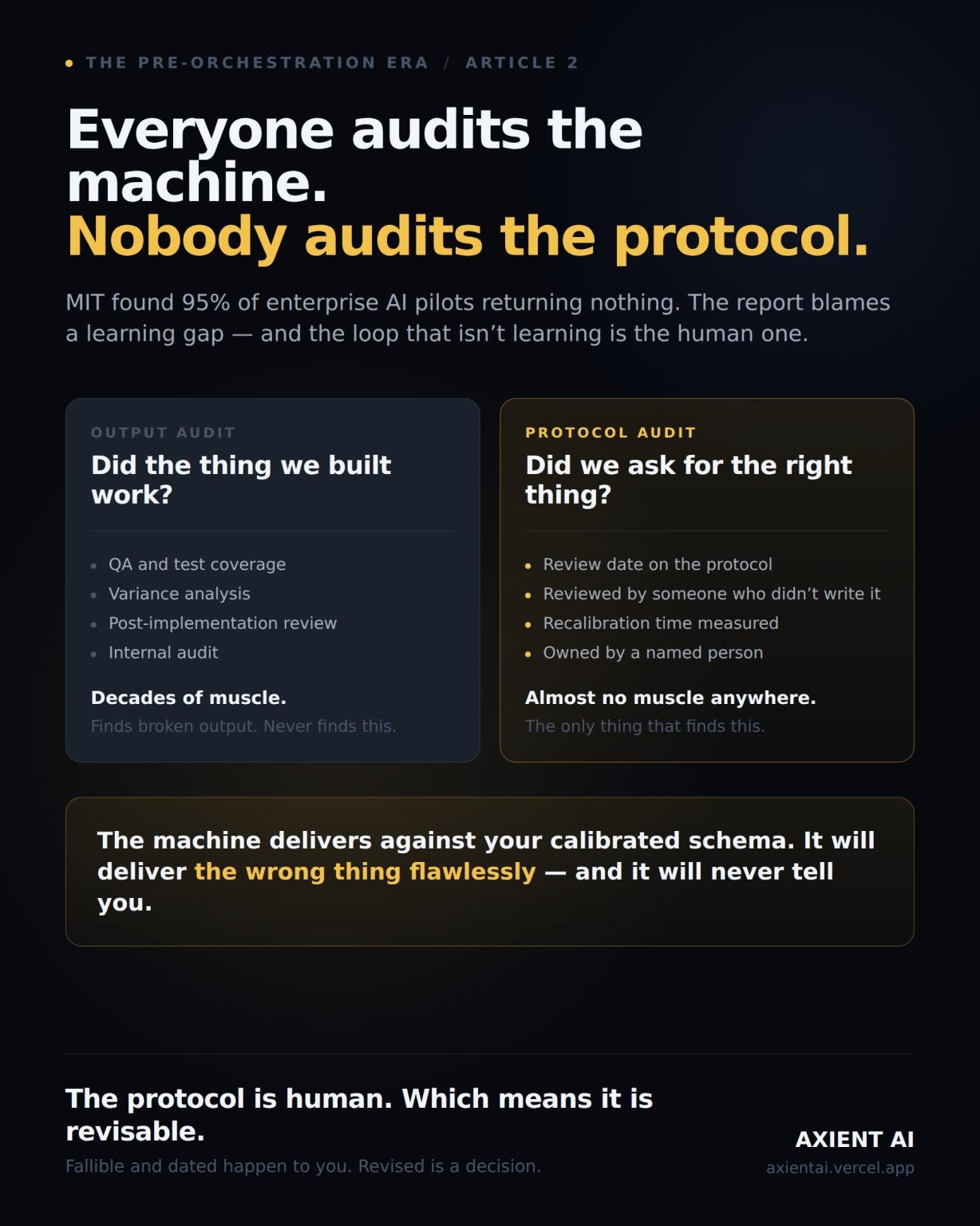
Read past the headline. The report does not blame the models. It blames a learning gap: systems that, in its words, do not retain feedback, adapt to context, or improve over time.
Right — and one level too shallow.
The loop failing to learn is not the machine’s. It is the one wrapped around it. The protocol. The definition of done. The quality gate. The thing a human wrote six weeks ago, when they knew less than they know now, and has not opened since.
We have decades of muscle for auditing output — QA, variance analysis, post-implementation review, internal audit. We are excellent at asking: did the thing we built work?
We have almost none for the instruction set. And output audit never finds this failure, because the output is not wrong.
The machine delivers against your calibrated schema. It will deliver the wrong thing flawlessly, and it will never tell you.
What changed
I stopped looking at the output and opened the protocol. Rewrote the QC gates with Opus, re-orchestrated the release cycle from the schema up.
Same five platforms. Same 1.5 million tokens. A week of ground, in about an hour.
Nothing changed in the model, the compute or the budget. Only the instruction — and that was mine to fix the whole time.
Four questions for a board. None is a technology decision.
- 1. Does your AI operating protocol have a review date? If not, it has expired.
- 2. Who audits the instruction set? Output audit tells you whether the machine did what you asked. Only protocol audit tells you whether you asked for the right thing.
- 3. Who reviews it who did not write it? Nobody catches their own specification error. I wrote the warning and still missed mine.
- 4. What is your recalibration time — the gap between this stopped working and the protocol changed? Most organisations do not own it, do not measure it, and run it in quarters.
None of this is really about AI.
It is about the rate at which humans must update their own operating assumptions — higher now than at any point in history.
The industrial revolution gave people a generation. Electrification, decades. The PC, a career.
This asks for a rewrite every few weeks — of the same nervous system that evolved to find a rule, learn it, trust it, and stop spending energy on it.
The protocol is human. Which means it is fallible, dated the moment it is written, and revisable.
The first two happen to you. The third is a decision.
Check your own signs. Especially the ones you have already corrected.
For my kids and yours.