
Yesterday I told you what broke on the way. Today I tell you what replaced it. I'm going to coin a term, and I want you to remember where you read it first.
Vibe Engineering.
Not vibe coding reheated. Not a rebrand of the thing that failed. Its opposite. Vibe coding gave you generation without discipline. Vibe engineering gives you engineering discipline — the review, the architecture, the testing, the depth — without the dev team standing between you and the outcome.
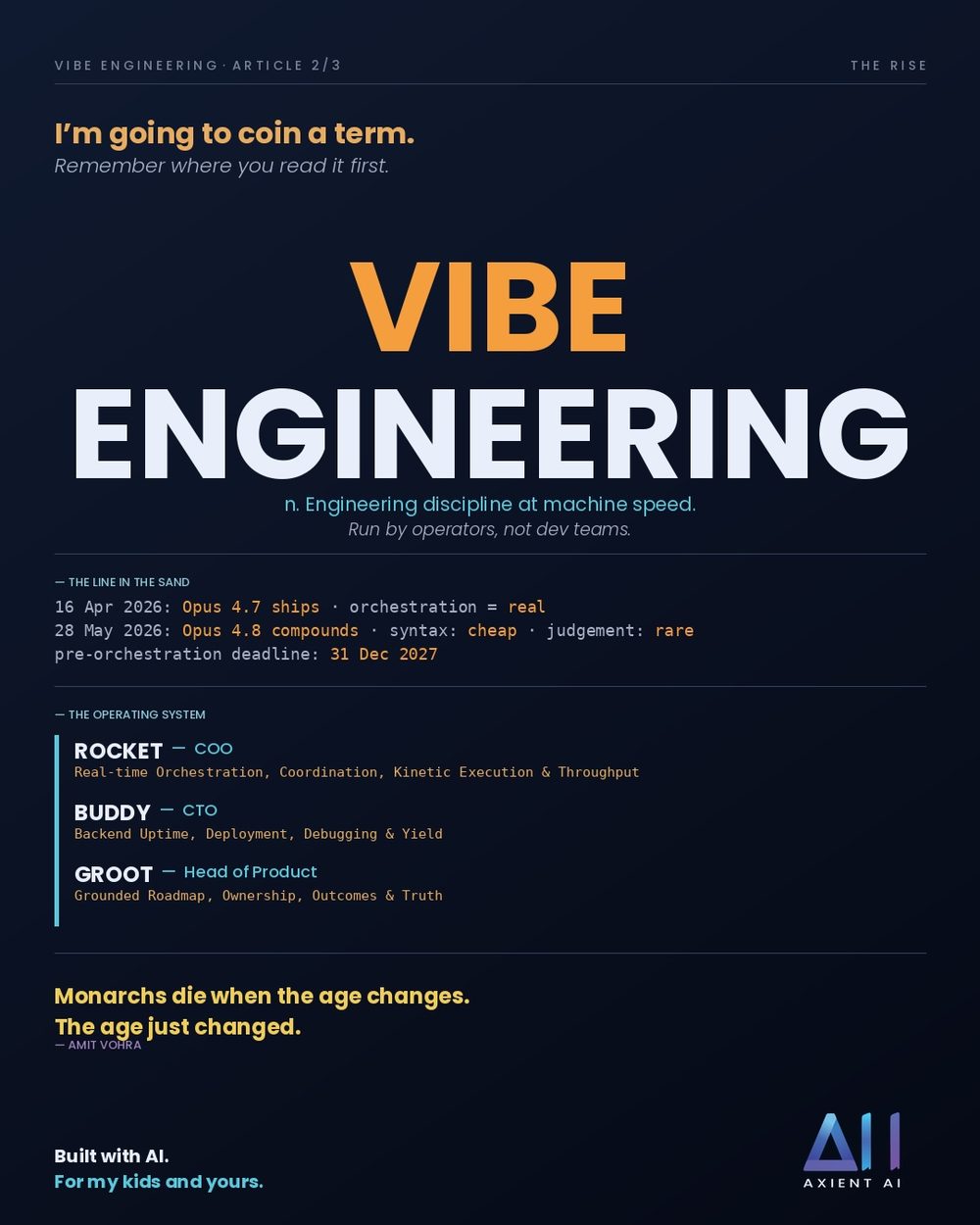
The concept has been on the table since early this year. Regular readers of my Symphony series watched me build the first working prototype of it in real time, in April, from mum's spare bedroom. What I didn't have then was a name for it. I do now.
After Opus 4.7 shipped on 16 April, and Opus 4.8 compounded the shift in May, this stopped being an option and became a necessity. And I mean that word precisely. Any company — tech or otherwise — that is not embracing, adopting, and implementing vibe engineering right now is doing two things at once: leaving money on the table, and quietly compounding tech debt they can't yet see.
They are becoming monarchs. And monarchs die when the age changes.
What vibe engineering actually is.
Traditional engineering on steroids. Same rigour. Same discipline. Same respect for architecture, security, and the boring things that keep systems alive at 3am. But run at a speed and depth that a human dev team physically cannot match — and run by a different kind of operator.
This is the part the industry keeps getting wrong.
Vibe engineering is not "engineers, but faster." It is 0-to-1 delivery, run by non-technical leaders who have tech know-how and something far rarer: the scar tissue. The gut-ripping, boardroom-bloodied experience of large and small projects that went catastrophically off the rails — over time, over budget, and sometimes over the cliff entirely. And the other kind of failure nobody names: the gold-plated delivery. On paper a win. In reality a monument to cost, delay, and a scope no customer ever asked for.
Every honest CEO knows both. We just only admit it in whispered conversations outside the boardroom — where inside, we still tow the line: "We had a win. No one could have fully predicted the cost of transitioning off legacy."
We were right then. We are dead wrong today.
Why the discipline matters more now, not less.
Let me be very clear, because this is where people misread me: the discipline is the whole point.
The ROCKET, BUDDY and GROOT ecosystem — my three-agent scaffolding that Symphony readers know by name — exists precisely so that vibe engineering is engineering and not vibes. ROCKET is my Chief Operating Officer. BUDDY is my Chief Technology Officer. GROOT is my Head of Product. I sit in the founder seat. That's the room. Same titles you'd find on any executive team that costs $2M+ a year in fully-loaded comp. I run the lot on one subscription — less than my monthly coffee bill. The three-lane protocol I called "buckets" is the only thing I built with my own hands. The rest — the actual code — came from telling my executives what I wanted in plain English, and holding the line on what "good" looks like.
Speed with no discipline is what killed vibe coding. Speed inside discipline is what makes vibe engineering the most real thing on the table.
Depth. Rigour. Reproducibility. Review. The machine can now hold all of it — if the person directing it knows what "good" looks like and refuses to accept the lie. That's the shift. Syntax became cheap. Judgement did not.
Why it can't be the engineers who lead this.
This is the uncomfortable part, so I'll say it plainly.
Engineering teams are, by design and by training, at a loss to think and work this way. Not because they aren't brilliant — because they've been optimised for a different job. They own a cost centre. They think in tickets, sprints, and scope. They are rewarded for building the thing correctly, not for deciding whether the thing should exist, what it's worth, and what happens to the P&L across the whole business if it ships late or ships gold-plated.
The exception proves the rule: the engineer who has crossed over into commercial management, who carries P&L responsibility across the business and not just their own line — that person can do this. Because they've learned to think like an operator.
And that is exactly the breed the next era demands.
The leaders who will unlock this value — who will become the operators the world needs as we move into pre-orchestration and orchestration — are the battle-hardened COOs, CEOs and CCOs who get their hands dirty with vibe engineering and deliver 0-to-1 projects without engineers.
Don't mistake me. The engineers are essential. Their role — infrastructure, planning, the deep foundations — becomes more important, not less. But the thinking, the direction, the 0-to-1 judgement call, will come from a different kind of executive. One who has sat in the room where the money was lost and learned exactly why.
Why next year is the deadline, not the horizon.
Two months ago, in Symphony Part 4, I put a stake in the ground: pre-orchestration by 31 December 2027. Two years ago the analysts said 2035. Earlier this year they moved to 2029. I said end of 2027. I still say it.
The short version: syntax is already cheap. Legacy systems are ripe — ripe for replacement, ripe for the picking. But the real vulnerability isn't legacy technology. It's legacy thinking and legacy structure. Those are what will unravel businesses at a pace we have never witnessed before.
The monarchs still believe their crown is the asset. It was the asset. Today it's the target.
Vibe coding was the herald. It was smacked down, and rightly so. But heralds don't announce themselves — they announce what's coming behind them.
What's coming behind it is vibe engineering. And the executives who pick it up now, while it's still called a coinage instead of a category, are the ones who will still be standing when the age turns.
I told you to remember where you read the term first.
Built in Delhi. For my kids and yours.