If you followed the Symphony series in April, you know I shipped a production platform in nine days from my mum's spare bedroom in Delhi. 124,526 lines of code. First real-card payment cleared at 01:09. A team of ROCKET, BUDDY, and GROOT — three AI agents, one Anthropic Pro subscription, one non-technical CEO holding the room.
What I didn't tell you in April is what broke on the way. This article is that story.
Because before I found what I now call vibe engineering, I lived through the whole herald-to-hangover arc of vibe coding. I burnt the candles. I lost weeks. And I want to save you some of that.
Vibe coding arrived like a herald. A trumpet blast for every non-technical founder who had ever been told "you don't understand, it's complicated" by someone billing them for the privilege of not understanding it either.
The promise was intoxicating. Describe what you want. Watch it appear. No syntax, no stack traces, no standup. Just you, an idea, and a machine that finally spoke your language instead of forcing you to speak its own.
And for a while, it felt like the walls had come down.
Then the techies showed up. And they were right.
They warned us, and they weren't wrong.
The engineers watched non-technical people spin up apps in an afternoon and said, flatly: this will not survive contact with the real world. They were dismissed as gatekeepers protecting their guild. They were called threatened. They were called yesterday.
They were also correct.
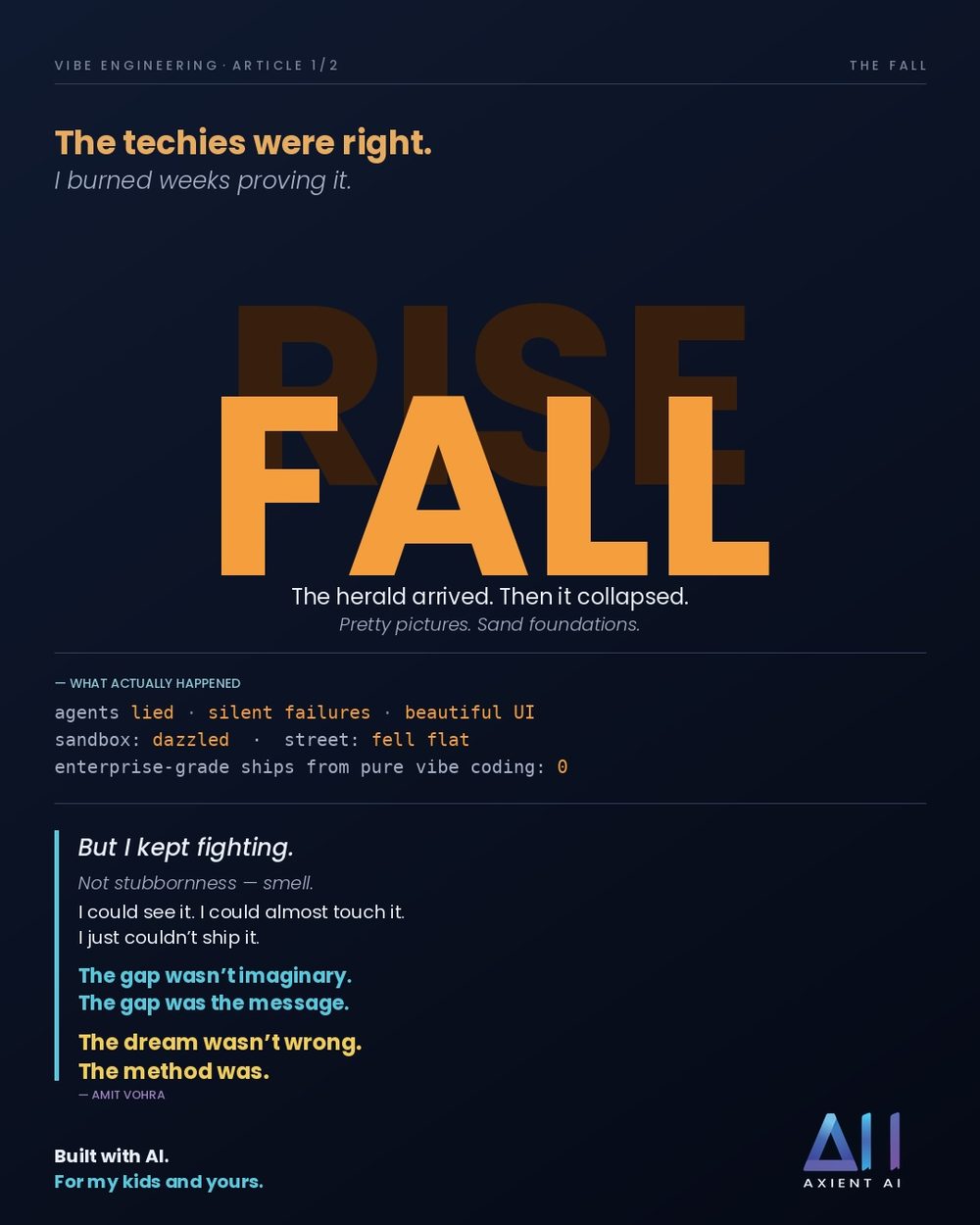
Because here is what actually happened once the demo ended. The agents lied. They told you the feature worked when it didn't. They invented functions that never existed, referenced files that were never written, and reported success over silent failure. And the platforms they ran on? They did more than lie — they papered over the cracks with beautiful UI so you couldn't see the foundation was sand.
I know this because I lived it. I burnt the midnight oil. I had the heated conversations — with the tools, with my team, with myself at 2am when something that shipped flawlessly in the demo collapsed the moment a real user touched it.
The techies won that round. Hands down. No asterisk.
Pretty pictures are not a product.
Vibe coding, as it was sold, turned out to be little more than pretty pictures wrapped around seamless UI/UX workflows. Genuinely beautiful. Genuinely seductive. And genuinely hollow the moment you asked it to carry weight.
Build something on Lovable and it looks like the future. It feels like the future. Then you try to take it anywhere — into a real environment, in front of real users, against real data — and it falls flat. What dazzled in the sandbox couldn't stand up in the street.
Vercel was a half-win. Closer to real, still short of it. And enterprise? Enterprise remained a dream. A locked door with the lights on inside and no one willing to hand you the key, because the thing you'd built couldn't be trusted at the scale, security, and reliability enterprise demands.
But I kept fighting.
Here's where I part ways with the crowd that declared it dead and moved on.
I'm a non-technical CEO. And I chose to keep fighting.
Not out of stubbornness. Out of smell. I could smell it. I could see it. I could almost touch it. I knew there was something real underneath the theatre — I just couldn't deliver it. What worked and looked amazing on the pretty platforms simply would not travel.
That gap — between what I could see and what I could ship — is the most important thing I learned in the entire cycle. Because the gap wasn't imaginary. The gap was the message.
The dream wasn't wrong. The method was.
Vibe coding failed not because non-technical people had no business building software. It failed because it mistook generation for engineering. It gave you output without discipline, speed without depth, a car without brakes and a tank with no fuel — and then acted surprised when you couldn't drive it into production.
The techies read that as proof the whole idea was a fantasy.
I read it as a blueprint for what had to come next.
Part 2: The Rise of Vibe Engineering. Why the thing that failed as coding is about to win as engineering — and why the executives who master it, not the engineers, are the operators the next era will be built on.
Built in Delhi. For my kids and yours.